
Why Daily Movement Matters More Than Your Best Workout
Consistency beats intensity. Here is how small, ordinary movement reshapes how you feel.
Read article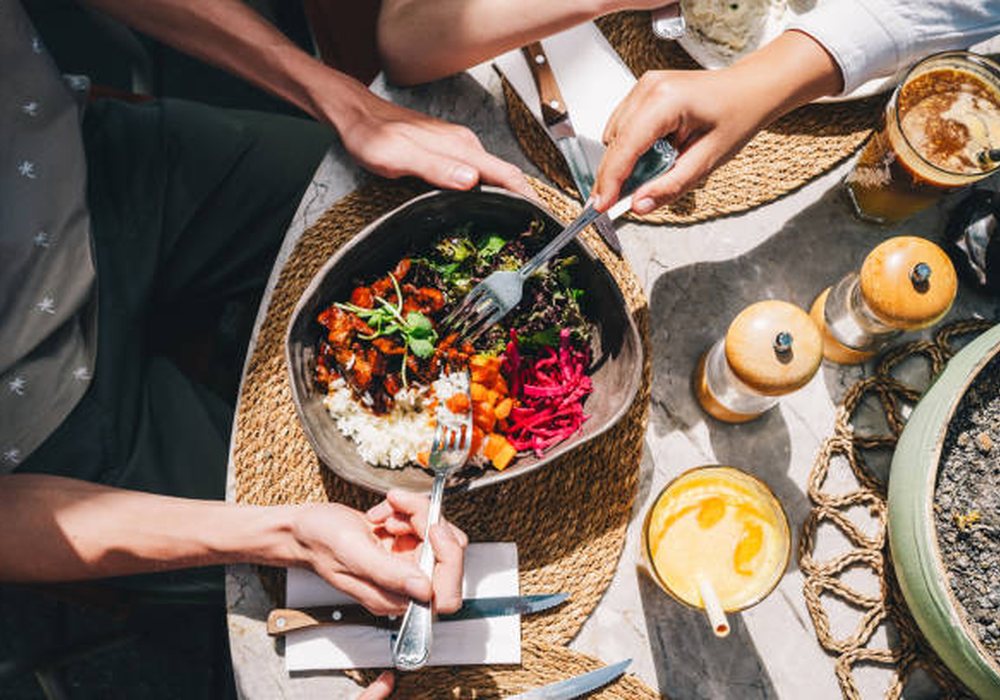
Counting every calorie or macro can feel reassuring at first. It rarely stays that way. Here is a calmer way to build meals that satisfy you — one that does not need an app, a scale or a spreadsheet.
Numbers feel precise, and precision feels like control. But food is not a laboratory exercise. The same meal lands differently depending on how you slept, how much you moved, how stressed you are and even how hungry you were before you started eating.
Counting also has a hidden cost: it turns eating into arithmetic. People describe losing touch with hunger, feeling guilty about food that did not fit the numbers, and avoiding meals with friends because they could not log them accurately. That is a lot to trade for a false sense of accuracy.
What we look for instead is a repeatable structure — something you can use at a restaurant, at your mother's table or at a service station, without a calculator.
The most useful thing on your plate is whatever grew from the ground. Vegetables and fruit bring fibre, water, colour and volume, which is why a plate built on them feels satisfying rather than restrictive.
Practically, that means giving produce the biggest share of the plate rather than treating it as a garnish. Keep a few options ready so this is easy on a tired evening: washed leaves, a bag of frozen vegetables, roasted trays from the weekend, tomatoes on the counter, fruit that is visible instead of hidden in a drawer.
Variety matters more than perfection. Different colours bring different nutrients, so if you eat mostly beige for a few days, add something green, red or orange when you next shop.
Protein is the part of a meal that helps you stay full and protects muscle, which matters at every age. Rather than weighing it, give it a defined spot on the plate and choose a portion roughly the size of your palm.
That could be eggs, fish, chicken, yoghurt, lentils, beans, tofu or paneer. Plant options count fully. If you eat mostly plant-based food, combining beans, legumes, grains and seeds across the day is usually enough.
Carbohydrates are not the villain they are sometimes made out to be. The grain or starch on your plate is often what makes a meal feel like a meal rather than a snack.
The useful question is not “how many” but “which one, and with what?” Whole grains, potatoes with the skin on, rice, oats, millet, bread with visible texture — these tend to be more filling, especially when they arrive alongside fibre and protein rather than on their own.
Fat carries flavour and slows digestion, which helps a meal last. Olive oil, nuts, seeds, avocado, nut butters, dairy or a little cheese all do this well.
A drizzle or a small handful is usually the difference between a meal that satisfies and one that leaves you searching the cupboard shortly afterwards.
A balanced plate is not a formula. It is a shape you can recognise in any kitchen, on any table, in any country.
Meals are only part of the story. A snack that combines something with protein or fat alongside a carbohydrate tends to hold you better than a sweet or salty item on its own — an apple with nut butter, curd with fruit, toast with hummus, a few nuts with a cup of tea.
Seconds are not a failure. If you are still hungry after a plate built this way, eat — appetite is information, not a moral test. What often changes is the type of second helping you reach for, because you are no longer eating against your own hunger.
Dessert belongs to a healthy pattern too. Food carries pleasure, celebration and memory, and a plate system that ignores this does not survive contact with real life.
Breakfast: yoghurt with fruit, seeds and oats, or eggs on whole-grain toast with tomato. Both are quick, both hold you until lunch.
Lunch: a bowl of whatever grain you cooked in bulk, with beans or chicken, a large handful of leaves and a dressing you actually like.
Dinner: a roasted tray of vegetables, a protein and a starch — and the leftovers become tomorrow's lunch, which is how good patterns survive busy weeks.
Some situations need more than a visual method: unexplained weight change, digestive symptoms, iron deficiency, a new diagnosis, eating difficulties, or a medical condition that changes how your body handles food. In those cases, personalised clinical guidance matters far more than a general article.
Our nutrition team works alongside your physician, so any plan is built around your actual health picture rather than a template.
Give plants the most space, give protein a home, keep a satisfying carbohydrate and let a little fat do its job. Eat when you are hungry, stop when you are comfortable, and let a few meals be imperfect. That is a pattern you can keep for years — and unlike counting, it does not demand your attention at every meal.
 Movement
Consistency beats intensity. Here is how small, ordinary movement reshapes how you feel.
Read article Sleep & Recovery
Sleep is the foundation everything else rests on. A gentle routine you can actually keep.
Read articleTell us what has been on your mind — a symptom, a goal, or simply a wish to feel better. We will help you find the right starting point and build the plan around you.